
Two weeks ago, a horrendous week of medical surprises began. That week and showed that medical issues of invisibly disabled people can get complicated. Today, I’d like to share with you another facet of my life: how medical care can be a challenge.
Condensed version: Two crummy problems. One still unresolved; one that seemed to last forever.
This strange journey started with unusual (actually, weird) hearing issues in my left ear. As is common with invisibly disabled people, diagnosis proved elusive. After ruling out several possibilities, the ENT ordered an MRI/MRA.
THE week
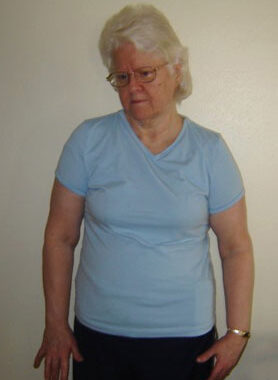
They scheduled my MRI/MRA on Monday, at 5 PM. I call it a “just in case,” as they didn’t expect to find anything. (They also checked on my long-standing brain aneurysm to be sure it remained unchanged.) Because of uncontrollable head movement from my cervical dystonia, the doctor prescribed Xanax to calm the movement. It worked; my head calmed; test went fine. The featured photo shows what my dystonia looked like ten years ago.

Then came Tuesday, 6 AM. Looking at my clock, I decided to get up. Uh-oh! What I remember next is pain from hitting my head on the nightstand on my way to the floor. I had profound weakness (not my normal kind ) and could not get back up. With great difficulty, FJ got me back into bed. Then he called 911; paramedics came; the ambulance transported me; ER ran tests. They found no concussion or head damage. Once home, I remained extremely weak and sleepy all day.
Five minutes after returning home from the ER, I received a phone call from my ENT about the MRI results. The radiologist saw something wrong: a possible blood clot. He used the words “possible stroke.” They wanted me to get an MRV (MRI of veins) to see the problem clearly. I wanted to wait until feeling better. But the doctor insisted it be done ASAP, and they scheduled it for Thursday with a Friday ENT follow-up.
More happenings
My thought processes were incoherent on Tuesday, so Joe had to take care of everything. In fact, for the next 4 days, I continued groggy and weak, improving slightly each day. I still have memory lapses from Tuesday. That entire week was a total loss.
Since the MRV was shorter than the MRI and my head was calmer, I used no sedatives. My head stayed still for the test. Yay!
At our visit Friday, my ENT reported there was no clot but there was stenosis (narrowing) of the vein. Therefore, he referred me to a stroke neurologist for follow-up.
The following Monday, I visited with my primary care doctor to get his take. He believed Xanax caused the fall and continuing problems. As to the MRV, he thought it showed a normal condition. But he referred me to a neurosurgeon. However, the neurosurgeon declined the referral, saying that type of problem was outside his purview. He referred me to a stroke neurologist!
So now, I wait. My appointment with that stroke neurologist is in three weeks. Hopefully, I will discover answers then, and they will be good.
Summing up
I know these kinds of medical problems can happen to anyone. But the already complex medical issues of invisibly disabled people, like me, can complicate matters. Were my case not already difficult, I may not have even needed the MRI. Without my cervical dystonia, I would not have needed the Xanax. If it weren’t for my weakness, the Xanax might not have affected me so seriously.

What do you think? Are medical issues of invisibly disabled people more difficult?

Read this post “Preparing for a Medical Emergency” for ideas to help you prepare for an emergency—disabled or not.
“3 Practical Things to Say & Do” shows how to help when a friend has a medically tough week.
Check out chapter 11 in Sunbreaks in Unending Storms for more stories of medical experiences.